We seem to be entering a new age of megaprojects as countries around the world mobilise the private sector to invest heavily in multi-billion or sometimes multi-trillion dollar infrastructure initiatives.
Megaprojects (sometimes also spelled “mega projects”) are very large investment projects and require care in the project development process to reduce any possible optimism bias and strategic misrepresentation.
The most expensive large-scale megaprojects in the world range from bridges, tunnels, highways, railways, airports, seaports, power plants, dams and wastewater projects to entire city districts.
Megaprojects seem to be practically recession-proof and have continued despite the 2008 global economic slowdown likely spurred megaproject construction, since the governments of some countries among them China, India, and the United States saw investment in infrastructure as a way to stimulate growth. Moreover, many large corporations are locked into megaprojects, because only enormous undertakings seem capable of nudging their bottom lines.
Here, we take a look at 5 of the biggest, most important and spectacular megaprojects around the world.
Waterworld Hotel Concept, Songjiang, China By Atkin’s Architecture GroupWaterworld Hotel, Songjiang, ChinaWaterworld Hotel, Songjiang, ChinaWaterworld Hotel Concept, Songjiang, China By Atkin’s Architecture Group
Songjiang Hotel, China
“We Drew Our Inspiration from the Quarry Setting” Says Atkins Design Studio
The five-star hotel is designed by UK architecture office Atkins for Shimao Group and will offer around 400 rooms, with underwater restaurants, clubs, shopping facilities, a 10-meter deep aquarium and various sport activities such as rock climbing and bungee jumping.
The waterfall is a key feature of this hotel built into a 328-foot-tall quarry outside of Shanghai. The 19-story hotel will have the waterfall cascading down the middle and two hotel floors that are entirely underwater.
The building will get its energy from geothermal sources and will feature a green roof.
With its 650 architects spread around the world in 60 offices, Atkins Design Studio is an enormous organisation, with some pretty amazing Megaprojects under its belt.
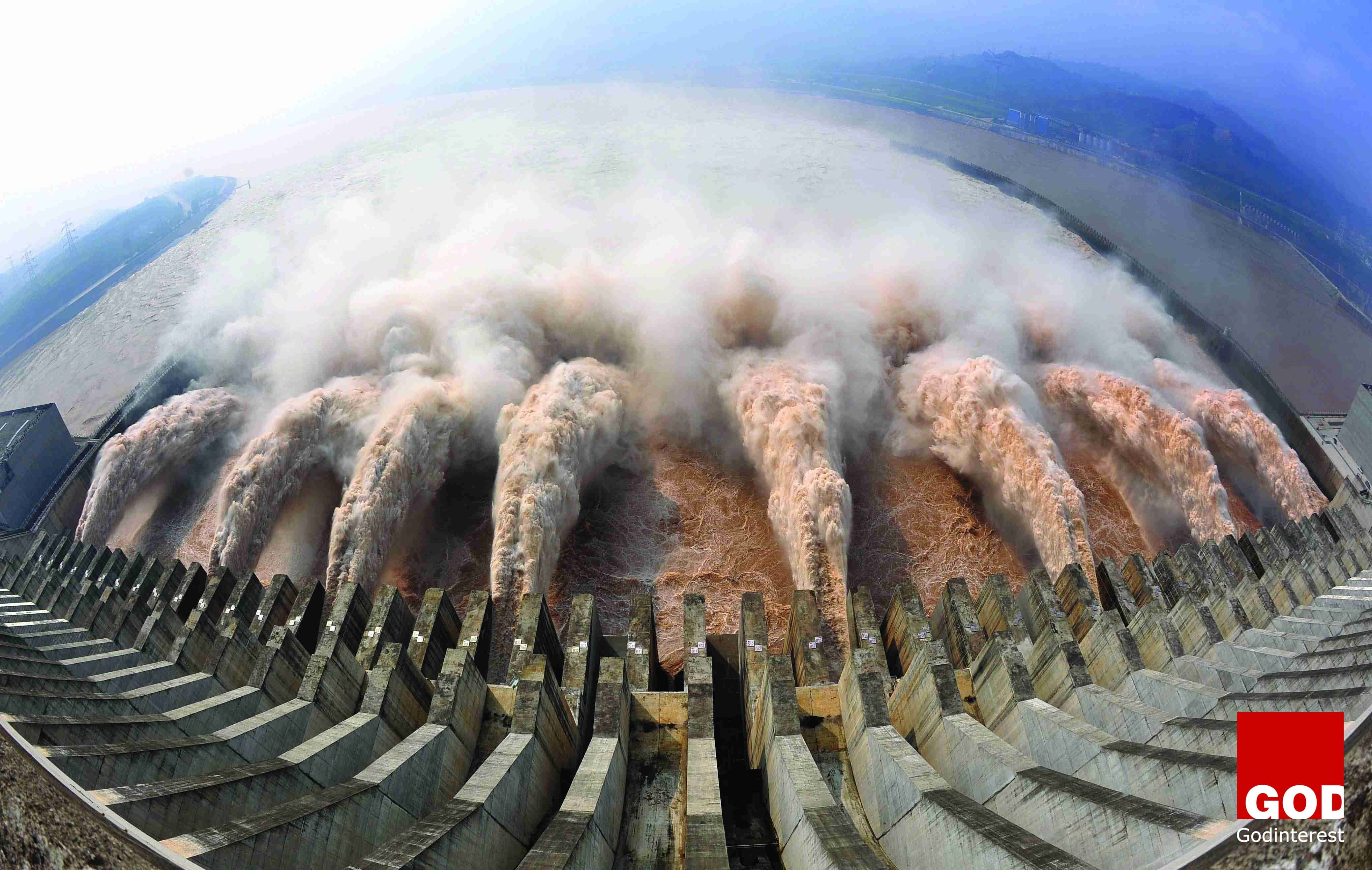
The Three Gorges Dam ProjectThe Three Gorges Dam ProjectThe Three Gorges Dam ProjectThe Three Gorges Dam Project
Three Gorges Dam
Man has long used technology to harness nature and dam building has always been one of the most controversial methods.
Building a dam causes dramatic effects on the environment, yet can benefit man in innumerable ways.
Three Gorges Dam located in Sandouping, Yiling, Hubeiis is the largest power station in the world and took 14 years to complete at a cost of USD $37 billion ( ¥180 billion). The original estimated cost was USD $6 billion ( ¥20 billion). It can produce as much as 15 nuclear power plants and is expected to create 10% of China’s entire energy supply.
The Three Gorges Dam has moved 39 trillion kilograms of water 175 metres above sea level which scientists believe has altered the planet enough to change the speed at which the earth rotates.
The dam was first suggested by Sun Yat-sen, the first president of the Republic of China in 1919 and people have been working on it, researching how it would work and where exactly it would go for nearly 100 years.
London Crossrail
London Crossrail
Crossrail is Europe’s largest infrastructure project and is set to boost London’s rail capacity by 10%. The project will deliver approximately 11.9km of twin bore tunnels.
The $23 billion development 73-mile rail project will connect London from East to West, improving access to Heathrow Airport, central London as well as city’s surrounding towns and suburbs.
Eight boring machines have been cutting their way through earth to create 26 miles (42km) of tunnels.
Construction of Crossrail began at Canary Wharf in London Docklands on 15 May 2009, with tunnelling work starting in May 2012.
The Crossrail project is about 65% complete and engineers will now continue upgrading existing stations and building new stations in central London and London Docklands.
Working in partnership with China Southwest Architectural Design and Research Institute and the China Railway Design Institute, ADPI also won the competition to design and develop Terminal 3 at Chongqing Jiangbei International Airport in 2011. Phase 1 of the project will increase the airport’s capacity to 45 million passengers per year by 2020.Beijing’s new international airportBeijing’s new international airport
Beijing International Airport Terminal 1 to be World’s Biggest
Beijing’s new international airport
January 2013 saw work approved for a new airport in Beijing. With large sweeping, non-conforming arches that span inwards with curves to the interior, there is a definite stamp of Zaha Hadid Architects with their design language.
Playing host to eight runways and with the capabilities to cater for 130 million passengers every year, Beijing’s new international airport will be among the world’s largest and busiest once complete in 2017.
International Space Station (ISS)
One Giant Leap for Mankind
International Space station
The International Space Station (ISS) is the largest artificial body in orbit and can often be seen with the naked eye from Earth.
It may be one of the most ambitious scientific ventures ever and also the largest masterpiece of the human engineering in orbit around Earth at present. The station consists mainly of habitable and science modules, external trusses and solar panels to provide power.
The ISS provides a platform to conduct scientific research including astrobiology, astronomy, human research including space medicine and life sciences, physical sciences, materials science, space weather and weather on Earth.
What exciting projects did we miss on our list? Let us know in the comments section below.
Project Journal had the privilege of interviewing AXELOS previous CEO Peter Hepworth. Peter provided us with an insight into his role and AXELOS as a whole in October 2015.
AXELOS CEO Peter Hepworth
Peter joined AEXLOS as CEO in July 2013 and was previously Managing Director for Activision Blizzard a $400 million turnover and $150million EBIT business. In 2014, Activision Blizzard was the fifth largest gaming company in the world by revenue.
Peter is an economics graduate, chartered accountant, with an M.B.A. from Cranfield and A.M.P. from INSEAD.
What is AXELOS?
AXELOS is a joint venture set up in 2014 by the Government of the United Kingdom and Capita, to develop, manage and operate qualifications in best practice, in methodologies formerly owned by the Office of Government Commerce (OGC).
AXELOS is an independent organisation, allowing the user community to focus more on the content of frameworks and guidance without much interference. The firm puts a heavy focus on the guidance given, ensuring the content is fuelled by good ideas to keep the ITIL structure up to date. But while the business has a combination of access to one of Britain’s largest corporations and the UK government, more than 75% of publication sales and Prince2 certification is sold outside of the UK, a trend that is growing faster due to emerging markets.
The company varies its training approach. Its Portfolio, Programme, and Project Management Maturity Model (P3M3), for example, encourages users to assess their performance against benchmarks. Mike Acaster, PPM portfolio manager, says: “PRINCE2 is applicable to many sizes of organisation, but sometimes it’s better to be a bit more specific. It’s about tailoring advice for that context. In some cases it has been tailored, and people don’t realise it’s PRINCE2 – you have to scratch the surface.
How do you view the future of project management?
After years of being associated with large engineering and construction projects, project management has moved beyond infrastructure. Firms across different countries and sectors now acknowledge the need to manage their processes and keep costs and timing under control. As businesses begin to recognise the importance of project management worldwide, questions are being asked about the standards required. AXELOS is focusing on how these can apply to different staff and situations, as well as how workers can develop a career path in project management.
Is AXELOS popular aboard?
“It’s hard to measure the adoption of our products, but if you look at the number of exams taken, you can see strong growth outside the UK, as well as in the UK,” he says. “In the US there’s a lot of interest, and the biggest international user of PRINCE2 is the UN, to make sure their aid development is correctly managed.
“Our Managing Successful Programmes (MSP) product was used to deliver the Olympic Games. I was in Tokyo after they had won the right to host Tokyo 2020 and the focus was ‘When can we have MSP?’ They want to see the same success as London has had.”
What are the future priorities for AXELOS?
“Career path. For the individual, it’s about how your career can develop. There’s a different skill set between project and portfolio management, and no linear route. It comes to modularisation. We have been able to offer different dimensions.
Cyber Resilience is next. Companies need to put more emphasis on improving their reactions to cyber attacks rather than continuing to focus on prevent. Although there are a number of standards and best practices in place to prevent cyber attacks, firms are still falling foul, and this is usually due to the internal attitude and people, rather than technology.
New products launched in 2015 include PRINCE2 Agile; Cyber Resilience Best Practice and Continuing Professional Development (CPD).
What’s next?
Young people are learning things online and changing how it is done. We want our members to feel proud about having AXELOS qualifications and have launched digital badges so that project professionals can display their mark of professionalism across popular social networks.
Digital badges are tokens that appear as icons and are awarded to signify learning achievements in a way that can be easily verified and shared online. Our members digital badge’s will hold and display information about their professional development activity as well as the issue date and an expiry date.
Individual workers, organisations and entire industries can benefit from badges. Badges are a new form of currency – a more transparent and efficient way to communicate the acquisition and development of workplace skills.
From AXELOS to Microsoft, IBM to Oracle, many leading companies have adopted digital badges as a form of recognition for continuing professional development and certifications. The individuals who earn these badges enthusiastically share them to LinkedIn, Twitter, Facebook and other online destinations. Once shared, anyone can verify the authenticity of and learn more about the individual’s abilities. That shareability and verification can make all the difference in a competitive job market, whether an individual aspires to move ahead in her current position or move into a different job.
We also want continued openness from AXELOS, even more community collaboration and specific actions to further increase the relevance of AXELOS in the future.
Where do you believe project management is heading?
Anyone can benefit from project management guidance. “We are all project managers now,” he says.
Since the dawn of time, mankind has used myths to make sense of the uncertainty that surrounds us. In the early 1990s a lot of people believed that project management was the best kept secret in business. However, because project management was not seen as a prevailing profession at that time, it suffered from a lack of awareness which was in a sense, a double edged sword. Those who were knowledgeable in the practice of project management became extreamly valuable to organisations and pioneers for the profession.
These early adopters were able to convince organisations that project management practitioners were needed. Myths around project management began to form in the business community and as the role of the project manager was unclear, questions were raised as to what project management was and what it could offer organisations.
The definition of the word myth is a “widely held, but false belief or idea.” Here, we’re going to examine 10 of the most pervasive PM myths that have emerged.
Myth #1 – Contingency pool is redundant
This is one of the most ‘mythical’ myths that has plagued the industry for a long time. Coupled with the tendency to presume that ‘real work’ is tantamount to implementation or building something concrete and you have the perfect recipe for project disaster. The thought pattern behind this approach typically originates from budget constraints and/or having unrealistic expectations. As we all know, or should know, the unexpected happens quite regularly. An effective contingency plan is important as it aims to protect that which has value (e.g., data), prevent or minimise disruption (e.g., product lifecycle), and provide post-event feedback for analysis (e.g., how did we fare? did we allocate funds correctly?).
Myth #2 – Project Management software is too expensive
If your idea of project management software involves purchasing servers, and purchasing a software application from a major vendor for a small practice with 10 practitioners then, yes, it is too expensive. If, however, you have gone cloud and elected to use a powerful web-based project management solution (such as Smartsheet), then you are likely to save thousands of pounds while reaping the benefits of a pay-as-you-go price structure. The present, and future, lie in cloud solutions that provide equal, or superior, functionality at a fraction of the cost.
Myth #3 – Project Management methodologies will slow us down
Project managers have a reputation of using process-intensive methodologies that favour ideology over pragmatism. In some instances this may, indeed, be the case when there is a mismatch between a specific project management approach and the organisation’s acutall needs (e.g., a process-driven method, such as PRINCE2, may not be appropriate for a slightly chaotic environment that favours an adaptive approach, such as Scrum). So, in sum, put down the paint roller (“Project Management isn’t for us!”) and take out your fine-bristled brush (“The Critical-Chain method may not be our cup of tea, but Agile on the other hand”¦”).
Myth #4 – Facts and figures are more important than feelings and perceptions
While facts are very important, projects are often derailed and sabotaged because of false perceptions. The PM must pay attention to both fact and fiction to navigate through turbulent organisational change.
Myth #5 – Project managers need to be detail oriented and not strategic in nature
While it is of the utmost importance for the project manager to understand how to read the details of the project, they must also understand how the project supports organisational objectives. Having a strategic perspective adds great value to the skill-set of the project manager.
Myth #6 Rely on the experts in everything that you do
It is true, we do need to rely on the experts but our trust can not be a blind faith. The job of the project managers in this area is twofold. First we must extract information and second we must verify that the information is accurate. A good example of this is asking a planner to provide an estimate on the effort required to perform a task. In some instances team members forget to include tasks which ultimately results in a faulty estimate.
Myth #7 All the battles have to be fought and won so that we can succeed
Project managers sometimes make the assumption that they need to stand firm to get the job done, however, coming to compromise on a particular issue is often a better course of action in order to win the war.
Myth #8 Project Managers can wear multiple hats
Wearing different hats can be extremely confusing. This is especially true if the project manager is asked to be a business analyst or technical expert on top of serving in their PM role. They end up doing both roles with mediocrity. When we “wear two hats” we essentially tell ourselves that both hats fit on one head at the same time. However, what happens if the demands of two roles conflict and what assurances do we have that we’re managing the inherent conflict of multiple roles and the risks the roles introduce? Sadly, multiple roles become more common as we move up the management hierarchy in an organisation, and that’s exactly where potential conflicts of interest can do the most harm.
Myth #9 Once the risk register is created, it’s full speed ahead
Risk management provides a forward-looking radar. We can use it to scan the uncertain future to reveal things that could affect us, giving us sufficient time to prepare in advance. We can develop contingency plans even for so-called uncontrollable risks, and be ready to deal with likely threats or significant opportunities. Too often, it’s not until a catastrophic event occurs and significantly impacts project progress that ongoing risk reviews are conducted.
Myth #10 Project managers can not be effective in their role unless they have specific technical expertise in the given field that the project falls within
You don’t need to be an engineer to manage a construction project or a IT technician to manage a software development project. All you need is a fundamental understanding with strong PM skills to manage the team. Experience in the field helps but does not guarantee success.
Project management is challenging enough without the myths. The profession has come a long way since the 1990s and some of these myths are fading. However, we still see remnants of them in one form or another. Great projects cut through false assumptions and confusion, allowing their teams to make smart decisions based on reality.
These are just 10 project management myths, what are yours?
Modular homes sometimes referred to as “factory-built construction“, encompass a category of housing built in sections typically at a factory location. These houses must conform to local and regional building codes for the country the buyer plans to situate the dwelling.
Just like site-built housing, construction teams build modular homes tolast and increase in value over time.As the factory finishes building sections of the house, each piece is transported to the homeowners build site on large truck beds.Local building contractors then assemble the house and inspectors ensure the manufacturer has built your residence to code.Most customers find that modular housing is less expensive than site-built homes.
1. Benefits of Construction
One of the benefits of construction is that manufacturers build them indoors in an enclosed factory setting, where the materials used to build the homes are not subject to adverse weather during construction.
Most building contractors can finish erecting a house in as little as 1-2 weeks, though it may take up to 4 weeks or more for local contractors to finish building the dwelling on-site once it has been delivered.
2. Differences Between Modular and Site Built
Modular homes are not the same as site-built homes, which contractors create 100% at the build site.That means the contractor must collect all the materials for a house and built it on-site. Like a modular home, the site-built home must conform to all regional, state and local building codes. Many refer to site-built construction as stick-built homes. Stick built housing is also well-built and designed to last a lifetime.
3. Difference Between Modular and Manufactured
Manufactured housing is another form of factory construction. Many consumers have mistakenly referred to these homes in the past as mobile homes. Others refer to manufactured homes as trailers. Manufacturers do build these houses in a factory like modular homes on a steel chassis.
The manufacturer then transports sections of the home to the building site as completed.These dwellings are usually less expensive than both modular housing and site built housing, in part because they don’t come with a permanent foundation.Trailers and mobile homes are more likely to depreciate than modular or site built homes.
4, Advantages of Modular Construction Over Site Built
Modular homes offer many advantages over traditional site built dwellings. Many consider modular homes a hybrid breed of housing.Not a manufactured house and not a site built house, these homes offer consumers multiple benefits including costs savings, quality and convenience.In many ways modular homes surpasses site built housing in quality and efficiency.
Modulars have grown up. They are more and more becoming a mainstreamselection for first time and secondary homebuyers.Most people now realise they don’t’ have to give up design quality or customization to buy a prefabricated house.One of the biggest misconceptions people have of prefabricated housing is they are look alike.“Boxy” is not a word that can begin to describe prefab dwellings. In fact, more suitable descriptions of these buidlings would include: “Elegant, durable, customised and high-class”.Many people find they can afford to include more specialization and customization when they buy a factory built house over a traditional stick built construction.
5. Cutting-edge Designs
Looking for a building design with a little pizzazz?You need to check out the latest architectural designs associated with prefabricated buildings.Firms are now building more elegant and unique designs to meet the increasing demands of selective customers.People are selecting modular designs over stick built designs to build their dream homes.
6. Customised Design and Modification
There are hundreds of companies that offer modular prefabricated construction kits and plans, and most employ various architects and specialized designers to help customize yourhome.That means you have more choices and a wider selection of designers to choose from.If you don’t find a style you like with one designer you can often move onto another, without even switching manufacturers.
7. Huge Range of Selection
Its always best to select a home that matches your lifestyle and design preferences.
8. Rapid Customisation
These are often the ideal selection for homeowners in need of a speedily designed homes.You simply can’t build a dwelling faster.Site built housing can take months to design and build.A manufacturer can design and place a prefab house in a few short weeks. You can pick from just as many different styles as you would a site built home if not more, but don’t have to wait weeks for contractors to build your custom house.
9. Precise Budgeting and Timing
Yet another benefit of these designs is the lack of guesswork involved.You don’t have to worry about how something will look.You know that everything will arrive to the build site complete and you will know the exact outcome. You also don’t need to worry about unexpected expenses, which is commonly the case with site built homes.With a prefabricated house, you know exactly what your home will cost and can control that cost from the point of buying to final construction.This isn’t the case with stick built housing. With stick built housing you also have to worry about surprises in the middle of construction.It isn’t uncommon for example, for a contractor to quit in the middle of a project.If this happens you have few choices.
Your home will sit partially built until you are able to find a new construction team.This alone may cost you valuable time and money.
10. Improved Energy Efficiency
Many prefab houses also come with what manufacturers call the “Energy Star” certification.This is a national company that promotes energy efficiency.Buildings with this label use 30-40 percent less energy yearly than traditional stick built housing.
This saves you time and money.Some key features of prefabricated housing that help improve energy efficiency include tight installation,high performance and weather resistant windows, controlled air systems and duct systems, upgraded air-conditioning and heating units and use of efficient lighting and heating appliances.As a bonus, these features not only save on annual energy costs but also improve the quality of your indoor air. Think energy efficiency isn’t significant?Think again.Over the lifetime of your house you could save thousands of pounds in energy bills by buying a prefabricated dwelling.
11. Design Modification is Easier
Most prefab homemakers now use computer aided design systems when conducting operations.This adds to the efficiency of construction and improves the appearance and architectureof homes.Prefabricated construction ranges from plain vanilla styling to intricate and complex modern designs.
12. On Time and on Budget
Perhaps the two biggest features or benefits of prefabricated housing that manufacturers hone in on are the speed thatthey can be built with and the competitive pricing they can offer on the final product.This is one reason that modular homes are gaining popularity.
13. Appreciate in Value
These dwellings also appreciate much like sitebuilt housing designs.Most homeowners are interested in building value in their house over time.Prefab housing afford you the opportunity to do this (keep in mind however much appreciation is dependent on real estate location).Select a good build site and your house will gain significant value over time. Other factors may also affect appreciation including landscaping and how well the house is cared for year after year.These factors also affect site built housing.Unlike mobile homes, which depreciate, a modular homeowner can expect to gain value from their home year after year. Study after study suggests that modular homes appreciate just as well as site built homes.They are also just as easily insured and financed.
As far as risk goes, you are no more at risk buying prefabricated housing than site built construction.
Modular Home Facts
Modular homes appraise the same as their on-site built counterparts do.
Modular homes can be more easilly customised.
Most modular home companies have their own in-house engineering departments that utilize CAD (Computer Aided Design).
Modular home designs vary in style and size.
Modular homes are permanent structures – “real property.”
Modular homes are considered a form of “Green Building.”
Modular homes are faster to build than a 100% site-built home.
Home loans for modular are the same as if buying a 100% site-built home.
Insuring your modular home is the same as a 100% site-built home.
Modular homes can be built to withstand 175 mph winds.
Modular homes can be built for accessible living and designed for future conveniences.
Would you consider a modular home for yourself, or are you more of a traditionalist?
Young Londoners have revealed that they would rather rent a tiny studio flat than a large property in a less desirable area.
We Haven’t Reached the Density of Hong Kong. But We’re Heading That Way
London’s population is expected to reach 10m by 2031 from its current 8.3m. London needs an estimated 49,000 new homes a year. This is not a new phenomenon, architects have confronted population growth and social changes before.
Obvious solutions include rental and shared ownership, while community building is also gaining ground in the UK. But there are other solutions out there, adding to the bigger picture. One of these is Pocket Living micro-flats, backed by Mayor Boris Johnson.
Micro-apartments Are in Vogue Today. But in Japan, People Have Been Living in the Nakagin Capsule Tower’s 100-square-foot Housing for Decades
Some 45% of 18-24-year-olds in London said they would consider living in a micro-flat if that was in the “perfect” location. A micro-apartment, also known as a micro-flat, is a one-room, self-contained living space, usually purpose-built, designed to accommodate a sitting space, sleeping space, bathroom and kitchenette with a size of 4-10 square meters.
They are essentially modern versions of the British bedsit and are becoming popular in urban centers in Europe, Japan, Hong Kong and North America, as they represent a seemingly straightforward antidote to persistent affordable housing shortages in dense growing cities.
In fact, some micro-apartments are being marketed as cost-effective fashionable lifestyle products.
Large one-room flat in LondonLarge one-room flat in London
Hogarth Architects transformed a large one-room flat in London into a stylish apartment using a wood insert that creates a separated kitchen and loft. It’s essentially one big piece of furniture custom-made for the space.
Curved surfaces can make a small space even smaller. The ability to organise the rooms vertically is reduced. But Dutch architects Queeste Architecten have managed to give this 320-square-foot micro-flat a spacious feel using lots of white, with built-in furniture and storage.
Guide price £8,000: the prototype of Ecodom’s portable micro house went to auction on 30 July
That oh-so-unfunny joke about moving into the garden shed is now a reality for young Londoners.
The prototype of a portable 130sq ft eco-friendly micro house that comes with a fold-down bed, kitchenette and shower room.
The micro houses, by Ecodom, will be constructed off-site and delivered fully made within two months of ordering, so it couldn’t be simpler to drop it into place and move straight in.
Oak Tube Apartment in Moscow
Architect Peter Kostelov turned a small flat into a oak-lined tube. Kostelov removed all the walls from the center of the apartment and replaced them with glass so light could get from windows on one side to the balcony on the other.
Specht Harpman Architects have turned a penthouse with a high ceiling into a two-level apartment and even managed to fit in a small grassy terrace.
Housing Complex in Slovenia is a Series of Honeycomb Modular Apartments
Japan’s famed Capsule Tower
When it was built in 1972, architect Kisho Kurokawa’s Nakagin Capsule Tower was meant to be the housing structure of the future. Now in 2013, his “masterpiece” stands dilapidated and virtually empty.
21 Rooms in One Creative Condo
Now here’s a solution that could revolutionize tiny spaces a slide-out system that turns a 350-square-foot space into 21 different rooms with bed, washing machine, entertainment, a bath covered by the bed when not in use, shelves, cabinets and more.
Do you believe higher density housing is the answer to London’s housing crisis as some believe or will it turn the city into Hong Kong and Shanghai?
Most people believe that the key to successful leadership is influence, not authority. Do you agree? The answer to that question, it seems, lies in whether the goal is to get others to work from a place of compliance or from a place of commitment which underlines the difference between influential leadership and authoritative leadership.
Working within an influential leadership model, committed employees will give up discretionary time to solve problems, serve customers, and think creatively. On the other hand, people working under command and control, as we more commonly know it will only work to achieve compliance, doing only what needs to be done to get by.
As a leader you must realise that every decision you make influences your next five decisions. Fortunately, great leaders are made, not born.
Maximise your effectiveness by emulating these words of wisdom that will motivate you in achieving your goals and overcoming your fears:
Build your own dreams, or someone else will hire you to build theirs — Farrah Gray
Perfection is not attainable, but if we chase perfection we can catch excellence — Unknown
proverb is to speech what salt is to food — Arabic Proverb
Hold fast to dreams, For if dreams die Life is a broken-winged bird, That cannot fly — Langston Hughes
Remember no one can make you feel inferior without your consent — Eleanor Roosevelt
We can easily forgive a child who is afraid of the dark; the real tragedy of life is when men are afraid of the light — Plato
Every strike brings me closer to the next home run — Babe Ruth
If I had six hours to chop down a tree, I’d spend the first four hours sharpening the axe — Abraham Lincoln
If you look at what you have in life, you’ll always have more. If you look at what you don’t have in life, you’ll never have enough — Oprah Winfrey
I can’t change the direction of the wind, but I can adjust my sails to always reach my destination — Jimmy Dean
Believe you can and you’re halfway there — Theodore Roosevelt
Twenty years from now you will be more disappointed by the things that you didn’t do than by the ones you did do, so throw off the bowlines, sail away from safe harbour, catch the trade winds in your sails. Explore, Dream, Discover — Mark Twain
To handle yourself, use your head; to handle others, use your heart — Eleanor Roosevelt
Too many of us are not living our dreams because we are living our fears — Les Brown
Whatever the mind of man can conceive and believe, it can achieve — Unknown
I am not a product of my circumstances. I am a product of my decisions — Stephen Covey
When everything seems to be going against you, remember that the airplane takes off against the wind, not with it — Henry Ford
The most common way people give up their power is by thinking they don’t have any — Unknown
It is during our darkest moments that we must focus to see the light — Unknown
Don’t judge each day by the harvest you reap but by the seeds that you plant — Robert Louis Stevenson
The only way to do great work is to love what you do — Steve Jobs
Change your thoughts and you change your world — Unknown
The question isn’t who is going to let me; it’s who is going to stop me — Ayn Rand
Remember that not getting what you want is sometimes a wonderful stroke of luck — Dalai Lama
You can’t use up creativity. The more you use, the more you have — Maya Angelou
I have learned over the years that when one’s mind is made up, this diminishes fear — Rosa Parks
I would rather die of passion than of boredom — Vincent Van Gogh
A person who never made a mistake never tried anything new — Unknown
If you want to lift yourself up, lift up someone else — Booker T. Washington
Limitations live only in our minds. But if we use our imaginations, our possibilities become limitless — Unknown
Certain things catch your eye, but pursue only those that capture the heart — Ancient Indian Proverb
How wonderful it is that nobody need wait a single moment before starting to improve the world — Unknown
The only person you are destined to become is the person you decide to be — Ralph Waldo Emerson
We can’t help everyone, but everyone can help someone — Ronald Reagan
Everything you’ve ever wanted is on the other side of fear — George Addair
Nothing will work unless you do — Maya Angelou
I alone cannot change the world, but I can cast a stone across the water to create many ripples — Mother Teresa
What we achieve inwardly will change outer reality — Plutarch
Courage is being scared to death, but saddling up anyway — John Wayne
Success is walking from failure to failure with no loss of enthusiasm — Winston Churchill
It always seems impossible until it’s done — Nelson Mandela
Successful and unsuccessful people do not vary greatly in their abilities. They vary in their desires to reach their potential — John Maxwell
Without ambition one starts nothing. Without work one finishes nothing. The prize will not be sent to you. You have to win it — Ralph Waldo Emerson
There are no traffic jams along the extra mile — Roger Staubach
Dreaming, after all, is a form of planning — Gloria Steinem
Stealing someone else’s words frequently spares the embarrassment of eating your own — Peter Anderson
The Book of Proverbs are the cream of a nation’s thought — Unknown
Life is 10% what happens to me and 90% of how I react to it — Charles Swindoll
The most difficult thing is the decision to act, the rest is merely tenacity — Amelia Earhart
When I was 5 years old, my mother always told me that happiness was the key to life. When I went to school, they asked me what I wanted to be when I grew up. I wrote down “happy”. They told me I didn’t understand the assignment, and I told them they didn’t understand life — John Lennon
A well crafted quote, very much like good storytelling and can elucidate fuzzy concepts. For example, creativity” and “innovation” are not the first two words that come to mind when talking about procurement. However, According to Deloitte’s paper Charting the Course, this is where procurement’s destiny lies.
By transforming beyond today’s definition of “procurement as the sourcing of raw materials, and goods and services,” procurement can reach new heights.
Here are 10 quotes to help you find motivation and inspiration to make a positive change.
All models are wrong but some of them are useful – George Box (Statistician)
People will forget what you said, people will forget what you did. But people will never forget how you made them feel – Maya Angelou (Writer)
We cannot solve our problems with the same thinking we used when we created them – Albert Einstein
Opportunity arises for the prepared mind – Louis Pasteur (chemist and microbiologist)
A journey of a thousand miles begins with a single step – Lao Tzu (Philosopher)
What gets measured, gets managed – Peter Drucker
Leonardo da Vinci’s Simplicity is the ultimate sophistication – Dale Dauten
Worrying does not empty tomorrow of its troubles, it empties today of its strength – Corrie ten Boom
The best way to predict the future is to invent it – Alan Kay
Strive not to be a success, but rather to be of value – Albert Einstein
What are some of your favorite inspirational quotes? Share in the comments
London needs over 30,000 new homes every year for the next 15 years to keep up with the demand from the people who wish to live and work in the city. Despite good housing output, figures published by the GLA show that there is a huge deficit in the number of affordable homes being produced, particularly larger homes.
A shortage of bricks is often cited as the main reason why developers are looking at new methods of construction to answer the demand for new homes. But brick is a major part of the London urban environment; planners often insist on this most familiar of materials, homeowners love its solid dependability. Therefore masonry is also becoming a modern technology to overcome the lack of skilled craftsmen available. Several companies have developed brickslip cladding systems which look like solid brickwork but need much less skill to install. Glued brickwork is another innovative approach introduced from Europe whose thin mortar joints produce a new sharper continental aesthetic.
Old Montague Street Student Accommodation
This Hall of Residence containing 219 Study bedrooms is set in the vibrant east end of London, just a few minutes walk from the Whitechapel Road the famous Brick Lane. The scheme consists of cluster flats of 6/7 bedrooms each sharing a kitchen, arranged over three floors above basement and ground floor commercial and ancillary accommodation. Provision of a formal courtyard for all access together with the vertical grouping of amenity space is an inherent part of the design. The accommodation is composed of offsite prefabricated pods which were brought to site finished with all fittings and fixtures clad with thin brick slip cladding.
Clients: Shaftesbury Housing Group and The London Institute
Architect: T P Bennett
Principal Supplier: Hanson Plc
Location: Don Gratton House, 82 Old Montague St, London E1 5NN
The term ‘Modern Methods of Construction’ (MMC) embraces a range of technologies involving various forms of prefabrication and off-site assembly.
MMC is increasingly regarded as a realistic means of improving quality, reducing time spent on-site, improving on-site safety and addressing skills shortages in the construction of UK housing.
Bridge Crossing Modern Design
The variety of systems now available potentially allows the designer enough choice to sidestep problems deriving from constraints posed by the use of any one method. MMC systems, from closed-panel timber framed systems to bathroom pods are a palette from which designers can make choices. They are not necessarily stand-alone solutions that anticipate all the needs of an individual site and can be mixed and matched as appropriate.
These limitations are not obstacles to achieving the good design in MMC-based schemes, but may hinder the incorporation of more complex and innovative types of MMC from which greater overall benefits may be obtained which are considered under the following headings:
1. COST UNCERTAINTY
There is no doubt that, given products of comparable performance the key issue in purchases of MMC construction systems is the price. At present not enough is known about the potential costs of using volumetric and closed panel systems to enable confident specification at an early date. This inhibits designers from exploring the full potential of MMC systems. This is particularly true of the less repetitive, small, one-off scheme, where a smaller margin of benefits is gained from using MMC. The principal barrier to the uptake of MMC, therefore, seems to be the perception of cost uncertainty with respect to using more complex systems. Without doing substantial project-specific research, consultants and their clients simply do not know with enough degree of certainty how much the volumetric or closed panel systems are likely to cost, and what would be the savings to overall project costs produced by potential speed gains to offset against increased capital expenditure.
This is due to the complexity of assessing the ratio of cost of repetitive elements where pricing is relatively straightforward to the cost of adjusting elements or building in another method for the abnormal condition. Decisions to use innovative systems are likely to be made once designs are well progressed to enable teams to be more certain of costs. This can increase the potential for change or result in design compromise as the designer attempts to incorporate the specific limitations of a particular system in their design.
In an attempt to improve this situation, the MMC consultant and or clients could pull together a directory of MMC expanded to include cost comparison data. The huge range of variables involved inevitably makes this difficult, but a database of current construction cost information would be an invaluable resource.
Contemporary Building Facade
2. PLANNING PROCESS AND EARLY COMMITMENT TO A SYSTEM
The time it can take to obtain planning permission has obvious implications both for project cost but also, in some circumstances, for architectural design innovation.
Most of the more complex types of MMC have an impact on dimensioning, the choice of external finish and detailing may have some effect on the buildings mass. Therefore, the construction system should be chosen prior to a planning application to avoid abortive work, redesign or amendment, or even resubmission for planning permission.
However, developers whose money is at risk, frequently hold off deciding on the construction technique until the last practicable moment, in order to get any advantage from fluctuations in material or component pricing.
Given the potential for lengthy duration of planning applications, this means that there is little incentive to prepare initial designs for planning with a prior decision to incorporate MMC firmly embedded. In cases where the developer has a financial or business link with the supplier, this is less likely to be the case. As the majority of commercial or residential developments involve some kind of arrangement with a developer, agreement on construction systems is often left to the stage after planning.
3. TIME INVESTMENT
Another very significant factor is the time investment required at the early stages of projects. This is needed to develop the design when the project is still at risk. There is a direct relationship between the scale and complexity of MMC component and the amount of time required to develop a design at an early stage.
The introduction of advanced or complex MMC techniques into the design process is potentially costly to the design team. A significant amount of research is needed to explore alternative systems, to obtain verification of suppliers’credentials, investigate mortgage and insurance issues, visit previous sites, talk to system suppliers, obtain technical performance guidelines, understand junctions and interfaces, coordinate other consultants, obtain building control input and so on.
For a consultant, the only way of investing in this research is either through timely payment of increased fees by a visionary understanding client or through the anticipation of increased future productivity through repetition when a project is phased, or large enough, or likely to be followed by another similar project.
The potential of learning a system and then being able to repeat lessons learned efficiently is a powerful incentive for both client and consultant. By contrast, HTA’ s project at Basingstoke is an example of a phased project with a three to four-year duration allowed the design team to repeat various elements of the design, and the manufacturer to develop improved solutions to technical and supply problems.
HTA’ s project at Basingstoke
4. INSUFFICIENT COMMUNICATION
Improved dialogue at the outset of the project is vital if design quality is to be maximised. Constraints and opportunities implicit within a particular system are more easily incorporated into design if partners communicate pre-planning. Increased early communication can be fostered through improved long-term partnering relationships.
Clients should also partner with a range of suppliers and architects so that choice and flexibility is not restricted.
5. INEXPERIENCE
Generally, the inexperienced client or design team will have to do more research, with the result that there is likely to be significant design development without a specific system being incorporated.
This is a disincentive to using a more complex system involving a higher proportion of MMC, where early decision making and knowledge of a system’ s capabilities have a decisive influence on the nature of the architecture. However, encouraging the take up of MMC through the use of a dedicated funding mechanism may assist clients in finding time for research into suitable MMC techniques.
Dome Construction Berlin
6. SUPPLIER’S ROLE
Site capacity studies and early stage pre-planning design studies could be undertaken directly by system suppliers on behalf of clients, cutting out the usual procedure of commissioning design work by independent consultants.
7. ASSUMPTIONS
There are a number of assumptions that are generally held about certain types of MMC that may have been valid at one time but are no longer true today. There is a need for reliable and up to date information comparing system criteria, performance data, timescales, lead in times, capacity, construction time, sequencing issues, limitations, and benefits.
Therefore it would be helpful if a forum for discussion and experience exchange was set up.
8. DEMONSTRATING THE BENEFITS OF MMC
There is still a large amount of skepticism about the need to go very far down the line with MMC. This is reflected in the acceptance of the desirability of maintaining or indeed enhancing the pool of traditional craft skills throughout the UK.
A balanced view is that there is a demonstrable need for the wider use of MMC which is recognized by both industry and government. The best way for clients and the public generally to become more confident and knowledgeable about the quality of design achievable through MMC is to see it demonstrated.
9. FINANCIAL INCENTIVES
There is no doubt that spreading the burden of investment through the life of a project helps to ensure a higher standard of specification and hence quality. In the Netherlands, a ‘ Green Financing’system has been developed by the Dutch government that provides favorable loan finance when certain sustainable standards are reached. In the UK, the Gallions HA has pioneered a study of this, based on a scheme in Thamesmead, ‘ the Ecopark project’.
Eco Park is an eco-friendly business park built on the False Bay coast. This business park is at the cutting-edge of sustainable design and offers a unique working environment in a secure, well-managed facility.
Apple will invest in 200 megawatts of solar energy projects in China and has pledged to work with factories in the region to source more renewable energy and improve their energy efficiency.
The tech giant, who base the majority of their manufacturing operations in China recently come under criticism due to the heavy pollution caused by its Chinese suppliers. The new energy project will offset the carbon produced by Apple’s supply chain in the region, where much of the electricity is produced from coal.
Lisa Jackson, Apple’s vice president of Environment, Policy and Social Initiatives, said “the 200 megawatts projects will produce the equivalent of the energy used by more by than 265,000 Chinese homes in a year and will avoid over 20 million tons of greenhouse gas emissions in China between now and 2020. These projects go beyond Apple’s operations in China to help our suppliers adopt clean renewable energy,”
The company now says its China operations are “carbon neutral”, as the solar installations produce more energy than is used by its offices and retail stores throughout the country.
Four years ago, Chinese environmental groups accused Apple of turning a blind eye as its suppliers polluted the country by emitting toxic gases and discharging heavy metal sludge. Furthermore, in the United States, Apple was criticised by environmental group Greenpeace in 2012 for relying too heavily on fossil-fuel-based energy to power its energy-hungry data centres.
On Wednesday, “Greenpeace said the company had taken a big step forward in greening its supply chain.”
Apple has also taken steps to operate more cleanly in its home state of California. In February, the iPhone maker said it would buy about $850 million of power from a new California solar farm to cut its energy bill and supply electricity for its new campus in Silicon Valley as well as other offices and stores.
Construction of the SIP Sports Centre has started in the Chinese city of Suzhou. The sports centre in Suzhou Industrial Park was designed by Ham burg’s star architects von Gerkan, Marg and Partner, and has been scheduled for completion in 2017.
The sports venue will be surrounded by residential quarters, a hotel and a leisure district offering community sports facilities and public spaces.
The development is being funded jointly by Sizhou City and Jiangsu Regional authorities and when complete, the complex will form part of the larger Suzhou Industrial Park.
Image: von Gerkan, Marg and Partners (GMP)Image: von Gerkan, Marg and Partners (GMP)
Hamburg Architects Designs for China’s Garden City
A spokesperson for architects von Gerkan, Marg and Partners said: “Suzhou is famous in China for its landscape design, and the masterplan for this new sports park is based on this tradition and reputation. In a modern interpretation of the city’s traditional gardens, an informally designed park landscape flows around the podiums that rise in straight lines from the surrounding streets and support the stadiums.”
The beautiful conspicuous undulating roofs that on all three stadiums make the ensemble into a landmark visible from afar. As visitors walk along the curved pathways, various viewpoints open up to pavilion architecture, stunning water features, and a breathtaking landscape. Its curved silhouette stands out from the urban environment, blending harmoniously with the landscape and the park at the Xietang River. In addition, the succinct character of the stadiums is reinforced by a uniform façade design. The façades of both stadiums and the podiums are structured by horizontal lines, which follow the shape of the buildings in elegant curves.
The roof of the covered 15,000 capacity multi-purpose hall located to the north-east of the site is supported by v-shaped columns which provide a rhythm to the transparent glass façade of the hall.
The Heart of the Community
The multi-functional sports centre will include three national-standard venues includes a 45,000-seat stadium, an indoor pool with 3,000 seats and a 15,000-seat indoor arena. With its wide range of functions, the park has been designed to ensure a permanent and sustainable flow of visitors.
The facility is well connected to the Metro and offers the Suzhou residents not only a park, but also various shops for day-to-day needs, thus creating an attractive centre for the new part of the city.
Change management is an approach to transition individuals, teams, and organisations to a desired future state. For over three decades, academics, managers, and consultants, realising that transforming organisations is difficult, have avoided the subject.
My Way or the Highway
Major organisational change is profoundly difficult because the structure, culture, and routines of companies often reflect’s persistent and difficult-to-remove ways of working, which are resistant to radical change even as the environment of organisations change.
What started out as a financial buzzword in the early nineties has become fundamental business practice, with executives recognising the need to keep abreast with the competition in a rapidly developing corporate new world.
Navigating change
Globalisation and the constant innovation of technology result in a constantly evolving business environment. There is an ever-increasing need for Change Management Lead’s / Senior Managers who can help organisations successfully navigate change in today’s business environments. The focus of this movement to date has been on how to partner with organisations to define education, training and communication platforms that help to support the change initiatives and concerns of company employees. The critical aspect is a company’s ability to win the buy-in of their organisation’s employees on the change initiative.
While a project team is important for success, a senior level advisor is invaluable and can work with an organisations leadership team to avoid common pitfalls that change management projects often fall into. There are four key areas where an Advisor should act as this resource as follows:
1. Defining A Strategy
Executives should start by asking themselves what exactly needs changing and why? Organisational change directly affects all departments from entry level employees to senior management and must be aligned to a companies strategy. Too many programs are heavy on the jargon and light on the substance. Executives are often sold on an idea only to realise as the change initiative begins that they need a different outcome, tool or process to be successful.
In this situation the strategy for change needs to be re-aligned with the organisation and its goals.
An outside senior advisor with a unique perspective of the organisation will play an important role in helping an executive to explore and shape the strategy they are defining and highlight whether it will truly create the outcomes they desire. This upfront partnership can save money on the back end of a project, by avoiding costly re-scoping of initiatives.This relationship between senior advisor and executive should therefore begin as early as possible in the process.
2. Coalition Building
Its important to give people multiple opportunities to share concerns, ask questions, and offer ideas and to make following up with answers and updates a top priority. Executives must reach out across their functional work streams to build a large cohesive team to support the project once the correct strategy has been set and the urgency for the project has been established. A good senior advisor will be able to guide an executive though these interactions.
As a senior change management professional, it is important that you help leaders of the organisation craft the correct message. While leaders often know what it is they want and see the urgency for themselves, the outside view that a coach provides can support the development of a team around the initiative and help to navigate the strategic and political interests in linking the change to the interest of multiple team members.
The more people are involved in the process, the fewer will be acting as internal saboteurs.
Communication Is Key to Successful Change Management
3. Communication
Don’t confuse process visioning, planning and endless powerpoint presentations with communication.
Change is uncomfortable, and adapting to change is messy. A Gantt chart can not capture the hard side of change management. Why? Because tasks are easy to list, but behaviour and long-held habits are not easy to change. Gather outside information, solicit perspectives, and adapt the approaches for your organisation and group.
The importance of communication within an organisation around the change cannot be underestimated. Executives often fall short on communication in two main areas, not communicating the right message and not communicating it frequently enough across an organisation. It is often thought that everyone else in the organisation is on board and understands the change, however, the reality for an executive is not the reality for another worker who may have lost a job because of a well intended change initiative. A senior advisor can apply consistent pressure to the leader of the change around the need for communication and its messaging.
Quantity Is Fine, but Quality and Consistency Are Crucial
4. Share Relevant Information Quickly
Most CEOs and managers are quoted as saying, “You can’t communicate too much,” Part of the communication will be the support the urgency in messaging. “My way or the highway” is often used, but is not an effective communication strategy. Senior Advisors can work with executives to tailor their message to each area of the organisation in order to define content that is important to them.
A study by Towers Watson shows that “only two-thirds (68%) of senior managers say they are getting the message about the reasons behind major organisational decisions. Below the senior management level, the message dwindles further to (53%) of middle managers and 40% of first-line supervisors understanding reasons behind major organisational change.
The forwarding and cascading of information does not work as consistent communication around the change will be necessary at all levels of the organisation using a variety of communication pathways and vehicles.As a trusted advisor it is important to encourage executives to lead by example in both their messaging and communication of the change agenda.
Only 25% of Change Management Initiatives Are Successful over the Long Term
Maintaining The Change
Many leaders and managers underestimate the length of time required by a change cycle. It is paramount that as the change effort reaches its completion that leaders of the change recognise that the process does not end there. The role of a Senior Advisor will be to guide them to the idea that work must be undertaken to maintain the change over time. Maintaining change does not mean that an executive must own the initiative forever, just that they take the necessary steps to ensure that change has a lasting impact by integrating the change into the corporate culture and measuring the benefits and highlighting areas for future improvements.
The outside unbiased view is that a Change Management Lead is crucial to the success of a change management program.
This article provides food for thought rather than counsel specifically designed to meet the needs of your organisation or situation. Please use it mindfully.
If you treat risk management as a part-time job, you might soon find yourself looking for one ’- Deloitte white paper (Putting Risk in the Comfort Zone)
I have learned that nothing is certain except for the need to have strong risk management, a lot of cash, the willingness to invest even when the future is unclear, and great people ’- Jeffrey R. Immelt
Thoughtfully assessing and addressing enterprise risk and placing a high value on corporate transparency can protect the one thing we cannot afford to lose trust ’- Dale E. Jones, vice chairman and partner with Heidrick & Struggles
We have no future because our present is to volatile. Will only have risk management ’- William Gibson
Risk management is a culture, not a cult. It only works if everyone lives it, not if its practiced by a few high priests ’- Tom Wilson
I think the rise of quantitative econometrics and a highly mathematical approach to risk management was the obverse of a decline in interest in financial history ’- Niall Ferguson
There is no doubt that Formula 1 has the best risk management of any sport and any industry in the world ’- Jackie Stewart
Stronger regulation and supervision aimed at problems with underwriting practices and lenders’ risk management would have been a more effective and surgical approach to constraining the housing bubble than a general increase in interest rates ’- Ben Bernanke
If you don’t invest in risk management, it doesnt matter what business you’re in, it’s a risky business ’- Goldman Sachs president Gary Cohn
Adventure without risk is Disneyland ’- Douglas Coupland
Risk and time are opposite sides of the same coin, for if there were no tomorrow there would be no risk. Time transforms risk, and the nature of risk is shaped by the time horizon: the future is the playing field ’- Peter Bernstein, Against the Gods
As population susceptibilities are better understood, we will be in a better position than we are in today to make informed decisions about risk management ’- Samuel Wilson
Take calculated risks. That is quite different from being rash ’- General George Patton
All courses of action are risky, so prudence is not in avoiding danger, but calculating risk and acting decisively ’- Niccolo Machiavelli
Total enterprise risk management is critical, but implementing it is both expensive and easier said than done. Even the most sophisticated financial institutions are still basically silo risk managers ’- Danny Klinefelter, Professor and Extension Economist with Texas AgriLife Extension, Texas A&M University
Playing it safe is the riskiest choice we can ever make ’- Sarah Ban
The question of whether or to what extent human activities are causing global warming is not a matter of ideology, let alone of belief. The issue is simply one of risk management ’- Malcolm Turnbull
Business people need to understand the psychology of risk more than the mathematics of risk ’- Paul Gibbons,
Risk comes from not knowing what your doing ’-Warren Buffett
You have to take risks. You will only understand the miracle of life fully when we allow the unexpected to happen ’- Paulo Coelho
Risk is a function of how poorly a strategy will perform if the ‘wrong’ scenario occurs ’- Michael Porter, Competitive Advantage
Risk management should be an enterprisewide exercise and engrained in the business culture of the organisation ’- OSFI Superintendent Julie Dickson, June 1, 2011 (courtesy Ethidex)
Risk is our business ’- Oswald Grübel, CEO at UBS
When our leaders accept the status quo, we run the risk of disaster ’- Max Bazerman from “Predictable Surprises”
The concept of ‘inherent risk’ is impossible to measure or even define. The idea of looking at risk absent all hard controls, soft controls, or mitigations, provides little or no useful information in most cases ’- Todd Perkins (from Journal of Applied Corporate Finance – volume 19 number 4)
It’s important to take risks but it’s idiotic to take them blindly ’- Terry Levine
Fail to identify the strategic risks and you fail as a business, no matter how well you manage your operational and project risks ’- Keith Baxter
Business as usual is business at risk ’- Deloitte white paper
Risk management is the identification, assessment, and prioritisation of risks ’- Wikipedia
Big Project Failures Claim Their Victims in Spectacular Fashion
You’ve just been assigned a high visibility failing project and you’re working round-the-clock to get the work to the client on time, despite the fact that the job bears barely any resemblance to the project you initially discussed. The scope keeps creeping, the risk and issue alerts are coming in thick and fast, the project is already two months past the original deadline, the clients are getting antsy even though they’re yet to provide you with various key pieces of information in order to baseline the project. Is this your chance to shine and showcase your skills?
If You Don’t Know Where You’re Going, You Will Probably End up Somewhere Else – Laurence J. Peter
If you manage to turn the project around and the project is successful, you will attract many fathers. However, if the project fails, you will probibly be offered up as the sacrificial lamb (scapegoat), there is absolutely no way around it. A high percentage of projects fail to deliver useful results, that’s a fact.
Project managers are regularly blamed for schedule delays and cost overruns for projects they inherit by no fault of there own, however, in most cases, the fault for such issues rarely lies with just one person.
Sufficient data has been gathered to indicate that blockers such as unsupportive management, senior sponsorship or low resource availability are as much to blame for project failure as ineffective stakeholder management or poor communication.
Capture all decisions
The only way to protect yourself is to ensure that you capture all decisions made in the project. In most cases many of these decisions will have been made by people above you. While you can influence decisions made by people under you. Get into the habit of building a dashboard early in the project and updating it each week with actuals. Also consider using a standard repeatable technique to analyse the health of your project.
Constrained resources
If you are in a project where resources are constrained, clearly outline the resources that you require to deliver the project in terms of time, scope, budget, risk and quality. If resources are pulled from your project, clearly articulate the affect of that in delivery terms and measure that to time delayed or cost added.
Risk and issues register
Operate a strong risk and issue register, ensure it is both visible and assessable so your team can actively participate in updating it.
Stop the project
Always remember, cancelling the project is not always a failure. There can be many reasons why the project may no longer be desirable now. If you have done your job well, you can be really successful by ensuring a project does not continue to meander along, wasting time and money when there is no possibility of completing the project.
Organisational change management
Unfortunately, the same can’t be said when there are organisation change management issues. While there are a few project managers who feel their jurisdiction ends at the triple constraint, most now understand the need to achieve the expected benefits from their projects.
So when is it fair to blame a project manager for poor implementation of a project’s deliverables, this is assuming that they were employed at the beginning of the project?
If they didn’t perform good stakeholder analysis during the project initiation stage as well as at regular intervals.
If they turned a blind eye and deaf ear to factors that could impact value achievement
If they didn’t insist on a clear communication strategy and progressive information sharing with relevant stakeholder groups.
If they didn’t engage influencers from key stakeholder groups throughout the project lifecycle.
If the organisation management deliverables were not built into the project’s scope definition and work breakdown structure.
Assuming the project manager was appointed at the start of the project and had undertaken all of the above, what are invalid reasons to blame the project manager if the project failed?
A lack of timely resource availability or commitment by the organisation
Directives to the project manager to not engage certain stakeholder communities
Ignorance by senior sponsors to management risks raised by the project team
A management decision that is too bitter a pill to swallow in spite of how much it has been sugar coated
Have any comments or stories that could help to expand this article?
The world of Procurement is seemingly full of impassioned people absolutely certain about what procurement is all about. Like other great lies, many of these half-truths and misleading ideas sound agreeable to the ears and comepackaged as good advice from influential people.
How many of these popular lies have you fallen victim to?
1. Procurement should have a seat at the C-table
It’s not so much an outright lie as an irritating half-truth – but the damage comes with what Procurement people do with it. The thought behind this is well-intended: Procurement people should be able to speak the language of senior executives as easily as they can talk about FIDIC or demand forecasting. Terms such as EBITDA, ROIC, and economic profit should be part of their everyday parlance. Procurement issues are often the least understood by the board and the CEO and must be explained in their language.
What on earth could be wrong with that?Nothing – if the Procurement people have full cognisance of their own tools and language – and can be persuasive to senior people of the value of Procurement.
Now, that’s where we have, what is kindly referred to, as a skills gap.
In reality, for Procurement with no reputation (outside of that pesky metric of cost) and few business-aligned projects to call upon, it can be incredibly hard to try and catch senior people’s ear – never mind a C-seat (see what I did there?).
2. You must carry out a competitive tender to obtain value for money
I’m trying to distance myself from the public sector here (noting I did co-author the CIPS book on contracting in the public sector) but even in the private sector there’s a desperate need to get three quotes.
Why three quotes?
Not five, not 11?‘Cos the rules say three; that’s why.
And the rules of Procurement policy and procedures, well, they can’t be broken because the CFO or the head of internal audit (all very commercial animals?) will be down on Procurement like a ton of bricks.
When the three quotes are received the following conversation occurs – the highest price is rejected – ‘they’re ripping us off’ followed by – and I love this one about the lowest price quotation – ‘the price is too low, they must have got the specification wrong’ – and the contract is awarded to the middle-priced one”¦.surely there’s a better way to deliver value for money?
Perhaps starting with actually defining it!
3. Procurement is the only source of governance for 3rd party spend
Being the only source would suggest a 100%, right?
I’d be amazed – and delighted – if Procurement governed half of all the 3rd party spend.Words such as ‘influencing’ are sometimes bandied about to shore up this lie. What a surprise that sales people are either trained, or very quickly learn ways, to actually bypass Procurement when selling.
And the reason?
Obviously marketing, IT, auditors fees, construction/property, recruitment (I could go on) is completely different, say the senior people in those departments – echoing the views of the oh so helpful sales people.And Procurement just never gets near, as they can’t articulate (deliver?) the value they can add.
I await the avalanche of people commenting on this telling me I’m wrong.Please be assured you are exceptional in Procurement.
4. Procurement welcome innovation and strategic relationships and anything other than lower price
Few businesses view Procurement as a strategic process. Most often, Procurement staff report to the CFO. This astonishing trend indicates that Procurement is still viewed as a financial / accounting activity and not an operational strategic activity that directly impacts the bottom line.
Suppliers; if you have an innovative product or service, recognise that Procurement’s ‘raison d’être’ is to deliver cost savings.That’s what they are measured on, that’s what the research with CPOs and the C-suite say is the #1 priority.There’s oodles of other priorities such as local sourcing, sustainability, innovation, partnering, risk management – I could go on and on and on.But that’s the one they get measured on. Think that through, next time you’re pitching.
The take-away
Perspectives on Procurement need to change, mature and grow up. Lies like these need to be re-evaluated and abandoned. Procurement needs to change the way they engage and manage suppliers and their internal stakeholders; ‘adding value’ (a dreadful phrase!) means so much more than asking for a discount.
Stephen Ashcroft BEng MSc MCIPS (speaking here, very much in a personal capacity!) is Associate Director, Procurement and Commercial Advisory at AECOM, a Fortune 500 company. He’s a procurement learner stuck in the body of a procurement veteran, and with over 20 years’ experience still sees the glass as half full. Working with leading organisations across diverse industry sectors, Steve helps clients reimagine procurement to drive improved performance. A recognised advisor, speaker, lecturer, and author; the ever-hopeful Kopite shares his bright-eyed/world-weary views on Twitter @ThinkProcure, LinkedIn and his blog.
Godinterest
Sharing the life changing Gospel message found in Jesus Christ
















 Curved surfaces can make a small space even smaller. The ability to organise the rooms vertically is reduced. But Dutch architects Queeste Architecten have managed to give this 320-square-foot micro-flat a spacious feel using lots of white, with built-in furniture and storage.